During my visit to Israel last November, I met up with an old friend, Paula Gaon, who has been living in Israel for many years now. She kindly agreed to an interview.
-So, how long have you been living in Israel?
21 years in September.
-Where did you live when you first moved to Israel?
I lived on a kibbutz near Jerusalem while studying in a university level ulpan (intense Hebrew language course) and working part-time on the kibbutz. It was a very interesting experience since most of the students were from the former Soviet Union. After ulpan, I even spoke Hebrew with a Russian accent. At the time, I didn't have much confidence about speaking to Israelis. So I tended to speak only with Russian speakers, a more level playing field.
-How long were you on the kibbutz, and what were your impressions of it?
I was on that kibbutz for only six months. This kibbutz was one of the large, veteran, very successful, kibbutzim. It seemed to have been very well managed - nothing wasted & kibbutz members very settled into their jobs. But, as an ulpan student and temporary resident, most members didn't take much notice of us, nor were they interested in getting to know most of us. Of course ulpanistim were given the least desirable jobs - like employees from manpower agencies & regarded as pretty disposable. In general, kibbutz members, at least at that time on that kibbutz, were quite closed to most things outside their world - including the need for common courtesy. I don't want to sound too negative here. The day-to-day life was really quite pleasant & it was wonderful having so many chores, like laundry & meals taken care of and very well done.
-Where did you go after the kibbutz?
After ulpan on kibbutz, the story starts to get complicated, at least time-wise. But looking back on it, I realize that it was really more the same. So I'll stick to the essentials.
After ulpan, I spent the next two and a half years on two other kibbutzim in the north, southern part of the Galilee. Both were religious and newer. Neither remained kibbutzim. As far as I know, both are now yeshuvim, settlements. I was actually up for membership on the first of the two, but soon saw that this was not going to be. In any case, I managed to get the kind of work on both that allowed me to hone language skills. So from there, I moved to Beit El in the Shamron Sumaria. Beit El was a large National Religious (Dati Leumi) Settlement. Understand that religious communities do not typically like single people, especially single women. So it was somewhat rare that I moved there. But they did areas that single people live in.
OK, so to continue with the Beit El chapter. I had been in Israel just over three years at this point. In all honesty, this is the time that I probably should have returned to the USA. Beit El was a very nice place, but I really came to understand the differences in Israeli and Ameriican mentality. For example, I was always invited by friends for sabbath and holidays meals. Why? Because a single person can't possibly manage. Have to admit that I did resent the fact that people wanted to feel sorry for me because I was single - couldn't understand that I've been alone most of my adult life and had long, long ago realized that that was not likely to change. They just couldn't get it and somehow felt that thay had to be partly responsibe for my well-being and at the same time resented the responsibility.
With all that, the four years at Beit El were nice ones. I came to realize that religious people are people just like everyone else - with the same challenges and obligations. And the people there are kind & decent folks.
My challenge was having to fall back on teaching elementary school English to earn a living. At the time, the Ministry of Education was so desperate for elementary English teachers that they financed certification courses for English-speaking academics.
I had substituted some, so they begged me to sign up for the certification course and teach a few hours at an elementary school in Jerusalem. This is the time that I referred to earlier as the time I should have returned to the USA. In all honesty, have to admit that I was worried about finding my niche in the American workforce, and being able to manage health insurance. Nonetheless, teaching in the public school system was a disaster from the very beginning - talking about a square peg in a round hole! The seminar did put me on probation for awhile, but they were so desperate that they even asked me to continue when I offered to quit. In any case, I did leave. But wasn't the only one. Most of those who went through this course eventually left. Looks like every body learned something from this experience.
***
2012-05-30
2012-05-29
Egypt: A Faded, Burdened Country
Michael Totten:
I never believed the uprising and palace coup that overthrew Hosni Mubarak would lead to a liberal democracy in the land of the pharoahs. I doubt Ajami did either. It isn’t what most Egyptians are yearning for, not at this time. And if most Egyptians don’t want it, who could possibly build it? ...Fouad Ajami has more.

2012-05-22
We Interrupt This Broadcast
Here is what I learned from watching half an hour of news on CNN:
1. BARACK OBAMA WAS NOT BORN IN KENYA.
2. Marvel Comics is going to have a character come out of the closet as gay, a development for which BARACK OBAMA opened the door. And speaking of BARACK OBAMA,
3. Will Smith will soon be starring in a movie about BARACK OBAMA.
4. And finally, I got to watch two women talking about prostate cancer.
1. BARACK OBAMA WAS NOT BORN IN KENYA.
2. Marvel Comics is going to have a character come out of the closet as gay, a development for which BARACK OBAMA opened the door. And speaking of BARACK OBAMA,
3. Will Smith will soon be starring in a movie about BARACK OBAMA.
4. And finally, I got to watch two women talking about prostate cancer.
2012-05-03
2012-05-01
Vandals Trash Valencia Street
This happened last night, within about two to five blocks of my house. A gang of Occupiers / anarchists / thugs vandalized a section of Valencia Street in the Mission District, San Francisco. Here's more from Mission Loc@al:
SFGate has more:
 ATM at 511/513 Valencia.
 Farina, across the street from the Women's Building (where I go for Friday night services at the Mission Minyan) was hit hard. Graffiti included things like "Yuppies out!"
 Windows were broken (not visible in this photo) at the Mission District police station.
 Weston Wear clothing store.
 Therapy.
 Even this dog boarding service on Mission Street was not spared the paint gun. Die yuppie puppies!
Not pictured here, but the whole front of ArtZone 461 was smashed and defaced. When I walked by there this morning, workers were re-painting the facade, and the glass storefront was boarded up. There were tracks of orange paint on the sidewalk from last night.
I am beyond disgusted.
UPDATE: OccupySF condemns vandalism.
A group of protesters vandalized dozens of businesses, cars and any property they came across as they marched through the Mission on Monday night. One person was arrested according to Sgt. Daryl Fong but no details about the arrest were made available yet.Read the rest at the link.
The mile-long trek of vandalism began at 18th and Dolores streets, where a group of more than 100 protesters met as part of an early May Day march. The protesters walked east on 18th Street, turned left on Valencia Street, right on Duboce Avenue, and made a right on Mission Street before being confronted by riot police at 14th and Mission, according to Justin Beck, an independent journalist who followed the protesters.
Police dispersed the crowd in the area of 12th and Folsom streets, Fong said.
In a statement released early Tuesday morning, Occupy San Francisco said the vandals were not associated with the movement, but the statement was taken down shortly after. ...
The vandalism began almost immediately after the group took off from Dolores Park at around 9 p.m. The protesters paint-bombed Tartine Bakery on 18th and Guerrero streets. When they reached Farina, one protester grabbed a chair and attempted to break a window but was not successful, said police officer D. Daza. Several of the protesters, dressed in black clothing and with their faces covered, threw sacks filled with paint at the restaurant’s windows, drew anarchist symbols on them and spraypainted “Yuppies out!”
Police confronted the protesters in front of the restaurant and a small group of them dispersed, but the main crew continued along Valencia Street. ...
SFGate has more:
Broken glass littered several streets in San Francisco's Mission District after protesters vandalized cars and buildings Monday night, including a police station.Go read it all.
The vandals were in a group that marched from Dolores Park shortly after 9 p.m., following a rally in advance of Tuesday's planned Occupy general strike, police said. Traveling down 18th Street and onto Valencia Street, the black-clad, masked protesters smashed windows with crowbars and signs, threw paint on buildings and spray-painted anarchy symbols on the hoods of parked cars. ...


Not pictured here, but the whole front of ArtZone 461 was smashed and defaced. When I walked by there this morning, workers were re-painting the facade, and the glass storefront was boarded up. There were tracks of orange paint on the sidewalk from last night.
I am beyond disgusted.
UPDATE: OccupySF condemns vandalism.
2012-04-10


2012-04-06
Jerusalem
Israel Diary, part 8.
Jerusalem is the capital of Israel.
You get off at the bus station in Jerusalem and you're on Jaffa Street. Head east on Jaffa and you're on your way to the Old City. That's about 30 to 40 minutes on foot. There's a brand-new light rail, too, that goes along Jaffa, but I haven't been on it.
From Tel Aviv to Jerusalem is from one country to another; I'm tempted to say another planet. In Tel Aviv, you might have gotten used to advertising posters with pictures of scantily clad women; in Jerusalem, you'll be hard pressed to find pictures of women in any state of attire. That's a symptom of the growing clout of the haredi (ultra-orthodox) community, and it's been the subject of some controversy lately; more on that later. Men wearing black hats, and women wearing a skirt and a kisuy rosh (head covering) are the rule, not the exception here.
Just before reaching the Old City, I turned off Jaffa Street and followed the directions I'd been given to Salomon Street. It's the site of Tmol Shilshom, a delightful cafe/restaurant/bookstore run by a friend of a friend named David. The establishment's name derives from the novel by S. Y. Agnon. If you go to Jerusalem, you need to visit Tmol Shilshom.

David had to divide his time between working and chatting with me, but we had some great conversation. He is originally from Tel Aviv but has been living in Jerusalem for 30 years. I asked him what was on his mind these days; he mentioned Iran. He said, "If we attack Iran, we risk losing the support of the international community." (I refrained from asking, "WHAT support?") He added, "We risk losing the support of the United States."
David also talked about the disappearance of women from public spaces in Jerusalem. It was the left-leaning Ha'Aretz, he said, that blew the whistle on this some months ago. No pictures of women on advertising posters, and no female voices on public announcements - this was the new trend in Jerusalem, at the behest of the pious haredim. I do not know exactly where the matter stands now, but it's been in the news and it's an ongoing struggle.
The Old City has seven gates; the one you'll approach from Jaffa Street is the Jaffa Gate. I entered through here.
There's a tourist information office just inside. I thought it would be a good idea to stop in there before going on. I asked for a tourist map in English, and the man at the counter gave me one, but I ended up being happier with my more detailed, Hebrew-language map of Jerusalem that I'd bought from a stationery store in Tel Aviv. I kept the map as a souvenir, though.
I had just one question. "Are there any places I shouldn't go?"
He thought about it for a moment. "No," he said. "No, it's fine." I don't know much about Jerusalem, but I wanted to play it safe.
I took the tour guide's hesitation as an admonition not to push my luck, so I confined my visit to the Jewish Quarter for this trip. I found my way to the Kotel (the Western Wall) and made the obligatory pilgrimage to its smooth, stony surface. I'd visited just twice before - eighteen and 24 years ago.
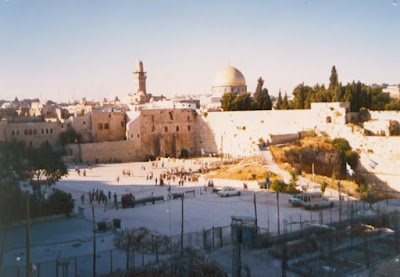 The Western Wall, Jerusalem, June 1987
After the security checkpoint, there's a couple of people posted to make sure visitors are dressed properly, and, on the men's side, the usual gaggle of men coming and going, prayer congregations in various sizes and stages of completion of the daily prayers, individuals reciting psalms or speaking from the heart, and a whole bunch of tourists just milling about aimlessly.


Over toward the mechitsa (gender divider), though, there seemed to be quite a bit of friendly cross-border communication between the men and the women. The women were praying and singing with great gusto - perhaps pointedly so, as the arrangements for men's and women's services at the Wall have been the subject of a great deal of contention. There is an organized movement for women praying at the Western Wall. From where I stood (and I didn't get close to the group, so I don't know for sure) it appeared that the men in this group were generally sympathetic to the women's right to pray expressively. At any rate, there was a great deal of audible singing and chanting from the women's side, and much conversation across the divider.
I spent a good two hours just wandering the streets of the Jewish Quarter. The Old City is like Borges' Aleph: small on the outside, but of nearly infinite size inside. But the streets are narrow like a labyrinth: it occurred to me that notwithstanding my earlier misgivings, the greatest peril to life and limb in the Old City is probably the danger of being crushed against the side of a building by a motor vehicle.
The 1948 Defenders' Plaza is spacious and lovely; down an adjoining alley, there is a memorial to those who lost their lives defending the Jewish Quarter in that war, in which all of the Quarter's 2000 Jewish inhabitants were evicted or killed. Our side took it back in 1967. 1948 Defenders' Square. (The year 1948 is represented as "Tashach" in Hebrew.)
As I sat on a bench on the Plaza, a bar mitzvah celebration came slowly winding into view. There were musicians blowing horns and banging drums, dressed in white, and, but for their long sidelocks, looking for all the world like Hare Krishnas. The boy seemed to be having the time of his life.
Jerusalem is the capital of Israel.
In Judaism, Jerusalem has been the holiest city since, according to the Hebrew Bible, King David of Israel first established it as the capital of the united Kingdom of Israel in c.1000 BCE, and his son Solomon commissioned the building of the First Temple in the city.
You get off at the bus station in Jerusalem and you're on Jaffa Street. Head east on Jaffa and you're on your way to the Old City. That's about 30 to 40 minutes on foot. There's a brand-new light rail, too, that goes along Jaffa, but I haven't been on it.
From Tel Aviv to Jerusalem is from one country to another; I'm tempted to say another planet. In Tel Aviv, you might have gotten used to advertising posters with pictures of scantily clad women; in Jerusalem, you'll be hard pressed to find pictures of women in any state of attire. That's a symptom of the growing clout of the haredi (ultra-orthodox) community, and it's been the subject of some controversy lately; more on that later. Men wearing black hats, and women wearing a skirt and a kisuy rosh (head covering) are the rule, not the exception here.
Just before reaching the Old City, I turned off Jaffa Street and followed the directions I'd been given to Salomon Street. It's the site of Tmol Shilshom, a delightful cafe/restaurant/bookstore run by a friend of a friend named David. The establishment's name derives from the novel by S. Y. Agnon. If you go to Jerusalem, you need to visit Tmol Shilshom.


David had to divide his time between working and chatting with me, but we had some great conversation. He is originally from Tel Aviv but has been living in Jerusalem for 30 years. I asked him what was on his mind these days; he mentioned Iran. He said, "If we attack Iran, we risk losing the support of the international community." (I refrained from asking, "WHAT support?") He added, "We risk losing the support of the United States."
David also talked about the disappearance of women from public spaces in Jerusalem. It was the left-leaning Ha'Aretz, he said, that blew the whistle on this some months ago. No pictures of women on advertising posters, and no female voices on public announcements - this was the new trend in Jerusalem, at the behest of the pious haredim. I do not know exactly where the matter stands now, but it's been in the news and it's an ongoing struggle.
The Old City has seven gates; the one you'll approach from Jaffa Street is the Jaffa Gate. I entered through here.
There's a tourist information office just inside. I thought it would be a good idea to stop in there before going on. I asked for a tourist map in English, and the man at the counter gave me one, but I ended up being happier with my more detailed, Hebrew-language map of Jerusalem that I'd bought from a stationery store in Tel Aviv. I kept the map as a souvenir, though.
I had just one question. "Are there any places I shouldn't go?"
He thought about it for a moment. "No," he said. "No, it's fine." I don't know much about Jerusalem, but I wanted to play it safe.
I took the tour guide's hesitation as an admonition not to push my luck, so I confined my visit to the Jewish Quarter for this trip. I found my way to the Kotel (the Western Wall) and made the obligatory pilgrimage to its smooth, stony surface. I'd visited just twice before - eighteen and 24 years ago.

After the security checkpoint, there's a couple of people posted to make sure visitors are dressed properly, and, on the men's side, the usual gaggle of men coming and going, prayer congregations in various sizes and stages of completion of the daily prayers, individuals reciting psalms or speaking from the heart, and a whole bunch of tourists just milling about aimlessly.


Over toward the mechitsa (gender divider), though, there seemed to be quite a bit of friendly cross-border communication between the men and the women. The women were praying and singing with great gusto - perhaps pointedly so, as the arrangements for men's and women's services at the Wall have been the subject of a great deal of contention. There is an organized movement for women praying at the Western Wall. From where I stood (and I didn't get close to the group, so I don't know for sure) it appeared that the men in this group were generally sympathetic to the women's right to pray expressively. At any rate, there was a great deal of audible singing and chanting from the women's side, and much conversation across the divider.

I spent a good two hours just wandering the streets of the Jewish Quarter. The Old City is like Borges' Aleph: small on the outside, but of nearly infinite size inside. But the streets are narrow like a labyrinth: it occurred to me that notwithstanding my earlier misgivings, the greatest peril to life and limb in the Old City is probably the danger of being crushed against the side of a building by a motor vehicle.
The 1948 Defenders' Plaza is spacious and lovely; down an adjoining alley, there is a memorial to those who lost their lives defending the Jewish Quarter in that war, in which all of the Quarter's 2000 Jewish inhabitants were evicted or killed. Our side took it back in 1967.

As I sat on a bench on the Plaza, a bar mitzvah celebration came slowly winding into view. There were musicians blowing horns and banging drums, dressed in white, and, but for their long sidelocks, looking for all the world like Hare Krishnas. The boy seemed to be having the time of his life.

2012-03-31


2012-03-30


2012-03-29


From Tel Aviv to Jerusalem
Israel Diary, part 4.
In Jerusalem, the dominant architectural theme is limestone; in Tel Aviv, it's Bauhaus. If you like Bauhaus, you'll love Tel Aviv.
To get from Tel Aviv to Jerusalem you catch the Egged line 405 bus. Egged's logo is a green Hebrew letter Aleph with wings; you could be forgiven for mistaking it for an X because of the way it's drawn, but it's an Aleph. The 405 leaves Tel Aviv from the Tachana Merkazit (Central Bus Station) at Retsif (platform) 607. It leaves on the hour and every 20 minutes, and takes one hour to complete the trip, give or take depending on traffic.
The bus station in Tel Aviv is in the southern part of the city, at the end of Levinsky Street. I'm told the #4 bus will get you there but I like to walk it. It's about 45 minutes on foot; you go south on Ben Yehuda and Allenby, then take Ha'Aliyah and Levinsky all the way to the end. Beginning from the corner of Bograshov, where the Maxim is, you'll pass posters for nightclubs and flyers for adult services. There are clubs and restaurants (some kosher, most not) and souvenir shops and those Judaica stores I mentioned. As you go south you get into the less touristy and more working-class neigborhoods. There are strip clubs and head shops. You'll pass a lot of derelict storefronts, failed or failing furniture and hardware stores. The population here looks to be mainly African and Russian. Down near Levinsky I see quite a few black hats, almost unknown up around the hotel.
By now I can pride myself on having the backpack check down to an art; I sling the pack over one shoulder and open the top before I get to the security guard, offering a quick "B'seder? Todah!" as I pass, and I'm on my way into the station. I've got a couple of one-shekel coins in my pocket in case I have to pee; the sherutim near the outbound gates are fee, but elsewhere the toilets are pay-to-play.
Pulling out, you pass some run-down cinderblock housing. You'll see graffiti. Here you'll see the cryptic mantra "NA NACH NACHM NACHMAN NACHMAN ME'UMAN", the signature of an ecstatic sect of hasidim, followers of Rabbi Nachman of Breslov. Elsewhere you might see "MARTIN BUBER WAS RIGHT" accompanied by Muslim, Christian, and Jewish religious symbols; it's a riposte to the original, less friendly slogan KAHANE WAS RIGHT. You'll see that one, too. And there are still those persistent posters proclaiming the late Lubavitch Rabbi the Messiah.
We are nothing if not colorful.
You get off at the bus station in Jerusalem and you're on Jaffa Street. Head east on Jaffa and you're on your way to the old city. That's about 30 to 40 minutes on foot. There's a brand-new light rail, too, that goes along Jaffa, but I haven't been on it.
From Tel Aviv to Jerusalem is from one country to another; I'm tempted to say another planet. In Tel Aviv, you might have gotten used to advertising posters with pictures of scantily clad women; in Jerusalem, you'll be hard pressed to find pictures of women in any state of attire. That's a symptom of the growing clout of the haredi (ultra-orthodox) community, and it's been the subject of some controversy lately; more on that later. Men wearing black hats, and women wearing a skirt and a kisuy rosh (head covering) are the rule, not the exception here.
In Jerusalem, the dominant architectural theme is limestone; in Tel Aviv, it's Bauhaus. If you like Bauhaus, you'll love Tel Aviv.
To get from Tel Aviv to Jerusalem you catch the Egged line 405 bus. Egged's logo is a green Hebrew letter Aleph with wings; you could be forgiven for mistaking it for an X because of the way it's drawn, but it's an Aleph. The 405 leaves Tel Aviv from the Tachana Merkazit (Central Bus Station) at Retsif (platform) 607. It leaves on the hour and every 20 minutes, and takes one hour to complete the trip, give or take depending on traffic.
The bus station in Tel Aviv is in the southern part of the city, at the end of Levinsky Street. I'm told the #4 bus will get you there but I like to walk it. It's about 45 minutes on foot; you go south on Ben Yehuda and Allenby, then take Ha'Aliyah and Levinsky all the way to the end. Beginning from the corner of Bograshov, where the Maxim is, you'll pass posters for nightclubs and flyers for adult services. There are clubs and restaurants (some kosher, most not) and souvenir shops and those Judaica stores I mentioned. As you go south you get into the less touristy and more working-class neigborhoods. There are strip clubs and head shops. You'll pass a lot of derelict storefronts, failed or failing furniture and hardware stores. The population here looks to be mainly African and Russian. Down near Levinsky I see quite a few black hats, almost unknown up around the hotel.
By now I can pride myself on having the backpack check down to an art; I sling the pack over one shoulder and open the top before I get to the security guard, offering a quick "B'seder? Todah!" as I pass, and I'm on my way into the station. I've got a couple of one-shekel coins in my pocket in case I have to pee; the sherutim near the outbound gates are fee, but elsewhere the toilets are pay-to-play.
Pulling out, you pass some run-down cinderblock housing. You'll see graffiti. Here you'll see the cryptic mantra "NA NACH NACHM NACHMAN NACHMAN ME'UMAN", the signature of an ecstatic sect of hasidim, followers of Rabbi Nachman of Breslov. Elsewhere you might see "MARTIN BUBER WAS RIGHT" accompanied by Muslim, Christian, and Jewish religious symbols; it's a riposte to the original, less friendly slogan KAHANE WAS RIGHT. You'll see that one, too. And there are still those persistent posters proclaiming the late Lubavitch Rabbi the Messiah.
We are nothing if not colorful.
You get off at the bus station in Jerusalem and you're on Jaffa Street. Head east on Jaffa and you're on your way to the old city. That's about 30 to 40 minutes on foot. There's a brand-new light rail, too, that goes along Jaffa, but I haven't been on it.
From Tel Aviv to Jerusalem is from one country to another; I'm tempted to say another planet. In Tel Aviv, you might have gotten used to advertising posters with pictures of scantily clad women; in Jerusalem, you'll be hard pressed to find pictures of women in any state of attire. That's a symptom of the growing clout of the haredi (ultra-orthodox) community, and it's been the subject of some controversy lately; more on that later. Men wearing black hats, and women wearing a skirt and a kisuy rosh (head covering) are the rule, not the exception here.
2012-03-19
Holy Grail
Israel Diary, part 3.
Religious Jews have a custom of washing hands with a two-handled cup on certain occasions: on waking in the morning, before meals featuring bread, after using the bathroom, etc. Although I've lapsed since those days, I was for a few years a practicing Orthodox Jew, and I've never really been able to shake the hold of traditional observance. It had been years since I'd washed with a washing cup, and I found myself missing the experience. So I decided this was the time to buy a wash cup; after all, I was in Israel.
I was in Israel, but I was in Tel Aviv.
From my diary:

Religious Jews have a custom of washing hands with a two-handled cup on certain occasions: on waking in the morning, before meals featuring bread, after using the bathroom, etc. Although I've lapsed since those days, I was for a few years a practicing Orthodox Jew, and I've never really been able to shake the hold of traditional observance. It had been years since I'd washed with a washing cup, and I found myself missing the experience. So I decided this was the time to buy a wash cup; after all, I was in Israel.
I was in Israel, but I was in Tel Aviv.
From my diary:
November 7, 2011I searched high and low in the touristy part of Tel Aviv, but I never did find those elusive wash cups. Two days later, though, I took the bus to Jerusalem. And the minute I got off at the Jerusalem bus station, what did I find?
Monday
16:58 (06:58 Pacific). More knick-knacks and goodies: a bottle opener (almost as elusive as the power converter, but they had it at the hardware store) and a set of silverware (also from the hardware store). From the stationery store I got a calendar and a notebook, and some maps.
Try to find a friggin' wash cup, though, and you're out of luck. They don't have religious products stores here. They do have Judaica stores, and you could probably find a fancy, gold-and-jewel-encrusted wash cup fit for King Solomon XIV, but not an ordinary one that normal people would actually use. Because, of course, normal people here don't use wash cups!

Subscribe to:
Posts (Atom)