“Are you Zionists?”And it goes downhill from there. Not to be missed.
My colleague Armin Rosen and I were supposed to be conducting the interview. Instead, we were put on the defensive before we could even ask our first question.
“Of course not,” I said.
“Nope,” Armin said. “I don’t have a Zionist bone in my body.”
We were at the headquarters for the UGGT, Tunisia’s biggest labor union, in the small city of Kasserine just down the road from Sidi Bouzid where the revolution—and the region-wide Arab Spring generally—began at the tail end of 2010 when fruit vendor Mohammad Bouazizi set himself on fire to protest crooked and onerous government regulation.
Four men sat in the union office with us. Armin and I wanted to hear about what happened in the early days of the revolt against Zine El Abidine Ben Ali’s autocratic regime, but they were in no mood to share such information with Zionists.
Our translator Ahmed Medien, a young and—shall we say—more cosmopolitan journalist based in the capital, Tunis, sat with us.
“What if we were Zionists?” I said, directing my question to Ahmed as much as to our interlocutors.
“They wouldn’t talk to you,” he said. ...
2012-05-31
Totten: Where the Arab Spring Began
Michael Totten has a sobering post on his recent visit to Kasserine, Tunisia:

2012-05-30
Interview: 21 Years in Israel (2)
[Interview with Paula Gaon, part 2.]
-I am interested in your take on the recent events in the Negev and South TA.
OK, my take on recent events in the Negev & South Tel Aviv. I take it you're referring to incidents involving refugees/immigrants from Sudan. In all honesty, I have not been following the news closely. And when I do catch snippets on the radio, can't help but wonder how accurate the stories are. Also, since I live in the Negev, don't have much feeling for the reality in Tel Aviv. But will give you a few impressions.
From what I see here in this little Negev town, most Sudanese are young men, some with families. From the hours they come and go & the buses they take, looks like they are working in service jobs at the Dead Sea, probably hotels and food services - not jobs people are anxious to take. I have no idea what percentage are employed, or if employed how legal it is. At any given time of day, young men are hanging around the downtown area and in apartment residential areas. But in all honesty, have no idea if they are employed or work night shifts.
When the Sudanese first came here about three years ago, people were suspicious and wondered if they were really refugees or illegals fleeing an awful situation. It looks like some have left, either sent back or decided to go back. But now I get the feeling, at least here, that on the whole, they are hardly noticed. My personal theory is that since this town is more than 40% immigrants, most from the former Soviet Union, residents feel more empathy with people who, for whatever reason, have been displaced.
As you can imagine, Tel Aviv is much more upscale than any town in the Negev. There are a lot more people with a lot more money, more upscale hotels and places of entertainment, more places that would require low-wage employment. The neighborhoods where the African refugees live, as far as I know, have always been poor Israeli neighborhoods with the reputation that many poor neighborhoods have. Get the picture? It doesn't take a great leap of imagination to see the potential for some serious friction.
According to news reports, African residents were attacked by young Israelis. Having worked in the school system, I'm not surprised by this. From my experience, politically correct has taken a strange twist here. Schools, for whatever reason, do not teach or enforce the idea of appropriate behaviour in the appropriate place. The idea of impulse control and expressing one's self inteligently, refraining from insults or attacks was not consistently taught or enforced. I've even heard Israelis aged 50 and above say the same. Why this has come to be - can't tell you exactly. But have gotten the feeling that this is a result of tensions in Israeli society among the different Jewish ethnic groups and has caused a kind of 'despair' regarding matters of discipline in the educational system. Nobody wants a fight, or risk an accusation of being against any Jewish ethnic group, so those in the educational system walk on eggs and make excuses.
In any case, it's terribly embarassing. Of course the USA has severly criticized Israel's racism. How soon they forget... But we do expect more from the Jewish State.
OK, now back to why I came to the Negev. It's very simple, actually. I've just always dug the Negev, Here's an interesting piece of trivia my town is almost the same latitude as Tucson.
On a more serious note, I moved to Jerusalem for perceived job opportunity. But personally, I find Jerusalem unlivable. It's terribly expensive. The cheaper areas are far flung, requiring long, nerve-racking bus trips - cars cost 4 times US price. And the security issues are abssolutely grinding. The Negev is cleaner, cheaper, and low-stress. I have a higher quality of life for a little less money.
***
-I am interested in your take on the recent events in the Negev and South TA.
OK, my take on recent events in the Negev & South Tel Aviv. I take it you're referring to incidents involving refugees/immigrants from Sudan. In all honesty, I have not been following the news closely. And when I do catch snippets on the radio, can't help but wonder how accurate the stories are. Also, since I live in the Negev, don't have much feeling for the reality in Tel Aviv. But will give you a few impressions.
From what I see here in this little Negev town, most Sudanese are young men, some with families. From the hours they come and go & the buses they take, looks like they are working in service jobs at the Dead Sea, probably hotels and food services - not jobs people are anxious to take. I have no idea what percentage are employed, or if employed how legal it is. At any given time of day, young men are hanging around the downtown area and in apartment residential areas. But in all honesty, have no idea if they are employed or work night shifts.
When the Sudanese first came here about three years ago, people were suspicious and wondered if they were really refugees or illegals fleeing an awful situation. It looks like some have left, either sent back or decided to go back. But now I get the feeling, at least here, that on the whole, they are hardly noticed. My personal theory is that since this town is more than 40% immigrants, most from the former Soviet Union, residents feel more empathy with people who, for whatever reason, have been displaced.
As you can imagine, Tel Aviv is much more upscale than any town in the Negev. There are a lot more people with a lot more money, more upscale hotels and places of entertainment, more places that would require low-wage employment. The neighborhoods where the African refugees live, as far as I know, have always been poor Israeli neighborhoods with the reputation that many poor neighborhoods have. Get the picture? It doesn't take a great leap of imagination to see the potential for some serious friction.
According to news reports, African residents were attacked by young Israelis. Having worked in the school system, I'm not surprised by this. From my experience, politically correct has taken a strange twist here. Schools, for whatever reason, do not teach or enforce the idea of appropriate behaviour in the appropriate place. The idea of impulse control and expressing one's self inteligently, refraining from insults or attacks was not consistently taught or enforced. I've even heard Israelis aged 50 and above say the same. Why this has come to be - can't tell you exactly. But have gotten the feeling that this is a result of tensions in Israeli society among the different Jewish ethnic groups and has caused a kind of 'despair' regarding matters of discipline in the educational system. Nobody wants a fight, or risk an accusation of being against any Jewish ethnic group, so those in the educational system walk on eggs and make excuses.
In any case, it's terribly embarassing. Of course the USA has severly criticized Israel's racism. How soon they forget... But we do expect more from the Jewish State.
OK, now back to why I came to the Negev. It's very simple, actually. I've just always dug the Negev, Here's an interesting piece of trivia my town is almost the same latitude as Tucson.
On a more serious note, I moved to Jerusalem for perceived job opportunity. But personally, I find Jerusalem unlivable. It's terribly expensive. The cheaper areas are far flung, requiring long, nerve-racking bus trips - cars cost 4 times US price. And the security issues are abssolutely grinding. The Negev is cleaner, cheaper, and low-stress. I have a higher quality of life for a little less money.
***
Chesler: Arest Mother as Accomplice in Sarah and Amina Said Killing
Phyllis Chesler:
Now, Phyllis writes, based on her communications with the girls' great-aunt Jill
On January 1, 2008, two American teenager sisters, 17 year-old Amina Said, and 18 year-old Sarah Said, were shot to death by their Egyptian father, Yaser Said, in Irving, Texas. After a lifetime of being physically and sexually abused by their father, the girls had finally decided to run away.DIL1 blogged about it here.
Sarah had rejected an arranged marriage with a much-older friend of her father’s whom she had never met. Both Amina and Sarah had boyfriends—and thus, their father viewed them as “whores” who had disobeyed the rules and who therefore deserved to die. ...
Now, Phyllis writes, based on her communications with the girls' great-aunt Jill
Abplanalp, she believes thatRead the rest at the link.
Texas-born Patricia (“Tissie”) Said, the mother of the two girls, should long ago have been charged as an accomplice in their honor killing. She is the one who tricked them, first by running away with them—and then by luring them back home in a series of phone calls. ...
According to great aunt Jill, there are three witnesses who can testify that, although Tissie ran away with her daughters, she did so in order to spy on them for Yaser; that all along, Tissie had planned to return to her husband—which she did. She knew that Yaser planned to kill his daughters. And nevertheless, upon her return, she started calling her daughters persistently.
Interview: 21 Years in Israel
During my visit to Israel last November, I met up with an old friend, Paula Gaon, who has been living in Israel for many years now. She kindly agreed to an interview.
-So, how long have you been living in Israel?
21 years in September.
-Where did you live when you first moved to Israel?
I lived on a kibbutz near Jerusalem while studying in a university level ulpan (intense Hebrew language course) and working part-time on the kibbutz. It was a very interesting experience since most of the students were from the former Soviet Union. After ulpan, I even spoke Hebrew with a Russian accent. At the time, I didn't have much confidence about speaking to Israelis. So I tended to speak only with Russian speakers, a more level playing field.
-How long were you on the kibbutz, and what were your impressions of it?
I was on that kibbutz for only six months. This kibbutz was one of the large, veteran, very successful, kibbutzim. It seemed to have been very well managed - nothing wasted & kibbutz members very settled into their jobs. But, as an ulpan student and temporary resident, most members didn't take much notice of us, nor were they interested in getting to know most of us. Of course ulpanistim were given the least desirable jobs - like employees from manpower agencies & regarded as pretty disposable. In general, kibbutz members, at least at that time on that kibbutz, were quite closed to most things outside their world - including the need for common courtesy. I don't want to sound too negative here. The day-to-day life was really quite pleasant & it was wonderful having so many chores, like laundry & meals taken care of and very well done.
-Where did you go after the kibbutz?
After ulpan on kibbutz, the story starts to get complicated, at least time-wise. But looking back on it, I realize that it was really more the same. So I'll stick to the essentials.
After ulpan, I spent the next two and a half years on two other kibbutzim in the north, southern part of the Galilee. Both were religious and newer. Neither remained kibbutzim. As far as I know, both are now yeshuvim, settlements. I was actually up for membership on the first of the two, but soon saw that this was not going to be. In any case, I managed to get the kind of work on both that allowed me to hone language skills. So from there, I moved to Beit El in the Shamron Sumaria. Beit El was a large National Religious (Dati Leumi) Settlement. Understand that religious communities do not typically like single people, especially single women. So it was somewhat rare that I moved there. But they did areas that single people live in.
OK, so to continue with the Beit El chapter. I had been in Israel just over three years at this point. In all honesty, this is the time that I probably should have returned to the USA. Beit El was a very nice place, but I really came to understand the differences in Israeli and Ameriican mentality. For example, I was always invited by friends for sabbath and holidays meals. Why? Because a single person can't possibly manage. Have to admit that I did resent the fact that people wanted to feel sorry for me because I was single - couldn't understand that I've been alone most of my adult life and had long, long ago realized that that was not likely to change. They just couldn't get it and somehow felt that thay had to be partly responsibe for my well-being and at the same time resented the responsibility.
With all that, the four years at Beit El were nice ones. I came to realize that religious people are people just like everyone else - with the same challenges and obligations. And the people there are kind & decent folks.
My challenge was having to fall back on teaching elementary school English to earn a living. At the time, the Ministry of Education was so desperate for elementary English teachers that they financed certification courses for English-speaking academics.
I had substituted some, so they begged me to sign up for the certification course and teach a few hours at an elementary school in Jerusalem. This is the time that I referred to earlier as the time I should have returned to the USA. In all honesty, have to admit that I was worried about finding my niche in the American workforce, and being able to manage health insurance. Nonetheless, teaching in the public school system was a disaster from the very beginning - talking about a square peg in a round hole! The seminar did put me on probation for awhile, but they were so desperate that they even asked me to continue when I offered to quit. In any case, I did leave. But wasn't the only one. Most of those who went through this course eventually left. Looks like every body learned something from this experience.
***
-So, how long have you been living in Israel?
21 years in September.
-Where did you live when you first moved to Israel?
I lived on a kibbutz near Jerusalem while studying in a university level ulpan (intense Hebrew language course) and working part-time on the kibbutz. It was a very interesting experience since most of the students were from the former Soviet Union. After ulpan, I even spoke Hebrew with a Russian accent. At the time, I didn't have much confidence about speaking to Israelis. So I tended to speak only with Russian speakers, a more level playing field.
-How long were you on the kibbutz, and what were your impressions of it?
I was on that kibbutz for only six months. This kibbutz was one of the large, veteran, very successful, kibbutzim. It seemed to have been very well managed - nothing wasted & kibbutz members very settled into their jobs. But, as an ulpan student and temporary resident, most members didn't take much notice of us, nor were they interested in getting to know most of us. Of course ulpanistim were given the least desirable jobs - like employees from manpower agencies & regarded as pretty disposable. In general, kibbutz members, at least at that time on that kibbutz, were quite closed to most things outside their world - including the need for common courtesy. I don't want to sound too negative here. The day-to-day life was really quite pleasant & it was wonderful having so many chores, like laundry & meals taken care of and very well done.
-Where did you go after the kibbutz?
After ulpan on kibbutz, the story starts to get complicated, at least time-wise. But looking back on it, I realize that it was really more the same. So I'll stick to the essentials.
After ulpan, I spent the next two and a half years on two other kibbutzim in the north, southern part of the Galilee. Both were religious and newer. Neither remained kibbutzim. As far as I know, both are now yeshuvim, settlements. I was actually up for membership on the first of the two, but soon saw that this was not going to be. In any case, I managed to get the kind of work on both that allowed me to hone language skills. So from there, I moved to Beit El in the Shamron Sumaria. Beit El was a large National Religious (Dati Leumi) Settlement. Understand that religious communities do not typically like single people, especially single women. So it was somewhat rare that I moved there. But they did areas that single people live in.
OK, so to continue with the Beit El chapter. I had been in Israel just over three years at this point. In all honesty, this is the time that I probably should have returned to the USA. Beit El was a very nice place, but I really came to understand the differences in Israeli and Ameriican mentality. For example, I was always invited by friends for sabbath and holidays meals. Why? Because a single person can't possibly manage. Have to admit that I did resent the fact that people wanted to feel sorry for me because I was single - couldn't understand that I've been alone most of my adult life and had long, long ago realized that that was not likely to change. They just couldn't get it and somehow felt that thay had to be partly responsibe for my well-being and at the same time resented the responsibility.
With all that, the four years at Beit El were nice ones. I came to realize that religious people are people just like everyone else - with the same challenges and obligations. And the people there are kind & decent folks.
My challenge was having to fall back on teaching elementary school English to earn a living. At the time, the Ministry of Education was so desperate for elementary English teachers that they financed certification courses for English-speaking academics.
I had substituted some, so they begged me to sign up for the certification course and teach a few hours at an elementary school in Jerusalem. This is the time that I referred to earlier as the time I should have returned to the USA. In all honesty, have to admit that I was worried about finding my niche in the American workforce, and being able to manage health insurance. Nonetheless, teaching in the public school system was a disaster from the very beginning - talking about a square peg in a round hole! The seminar did put me on probation for awhile, but they were so desperate that they even asked me to continue when I offered to quit. In any case, I did leave. But wasn't the only one. Most of those who went through this course eventually left. Looks like every body learned something from this experience.
***
2012-05-29
Egypt: A Faded, Burdened Country
Michael Totten:
I never believed the uprising and palace coup that overthrew Hosni Mubarak would lead to a liberal democracy in the land of the pharoahs. I doubt Ajami did either. It isn’t what most Egyptians are yearning for, not at this time. And if most Egyptians don’t want it, who could possibly build it? ...Fouad Ajami has more.
2012-05-22
We Interrupt This Broadcast
Here is what I learned from watching half an hour of news on CNN:
1. BARACK OBAMA WAS NOT BORN IN KENYA.
2. Marvel Comics is going to have a character come out of the closet as gay, a development for which BARACK OBAMA opened the door. And speaking of BARACK OBAMA,
3. Will Smith will soon be starring in a movie about BARACK OBAMA.
4. And finally, I got to watch two women talking about prostate cancer.
1. BARACK OBAMA WAS NOT BORN IN KENYA.
2. Marvel Comics is going to have a character come out of the closet as gay, a development for which BARACK OBAMA opened the door. And speaking of BARACK OBAMA,
3. Will Smith will soon be starring in a movie about BARACK OBAMA.
4. And finally, I got to watch two women talking about prostate cancer.
2012-05-03
2012-05-01
Vandals Trash Valencia Street
This happened last night, within about two to five blocks of my house. A gang of Occupiers / anarchists / thugs vandalized a section of Valencia Street in the Mission District, San Francisco. Here's more from Mission Loc@al:
SFGate has more:
 ATM at 511/513 Valencia.
 Farina, across the street from the Women's Building (where I go for Friday night services at the Mission Minyan) was hit hard. Graffiti included things like "Yuppies out!"
 Windows were broken (not visible in this photo) at the Mission District police station.
 Weston Wear clothing store.
 Therapy.
 Even this dog boarding service on Mission Street was not spared the paint gun. Die yuppie puppies!
Not pictured here, but the whole front of ArtZone 461 was smashed and defaced. When I walked by there this morning, workers were re-painting the facade, and the glass storefront was boarded up. There were tracks of orange paint on the sidewalk from last night.
I am beyond disgusted.
UPDATE: OccupySF condemns vandalism.
A group of protesters vandalized dozens of businesses, cars and any property they came across as they marched through the Mission on Monday night. One person was arrested according to Sgt. Daryl Fong but no details about the arrest were made available yet.Read the rest at the link.
The mile-long trek of vandalism began at 18th and Dolores streets, where a group of more than 100 protesters met as part of an early May Day march. The protesters walked east on 18th Street, turned left on Valencia Street, right on Duboce Avenue, and made a right on Mission Street before being confronted by riot police at 14th and Mission, according to Justin Beck, an independent journalist who followed the protesters.
Police dispersed the crowd in the area of 12th and Folsom streets, Fong said.
In a statement released early Tuesday morning, Occupy San Francisco said the vandals were not associated with the movement, but the statement was taken down shortly after. ...
The vandalism began almost immediately after the group took off from Dolores Park at around 9 p.m. The protesters paint-bombed Tartine Bakery on 18th and Guerrero streets. When they reached Farina, one protester grabbed a chair and attempted to break a window but was not successful, said police officer D. Daza. Several of the protesters, dressed in black clothing and with their faces covered, threw sacks filled with paint at the restaurant’s windows, drew anarchist symbols on them and spraypainted “Yuppies out!”
Police confronted the protesters in front of the restaurant and a small group of them dispersed, but the main crew continued along Valencia Street. ...
SFGate has more:
Broken glass littered several streets in San Francisco's Mission District after protesters vandalized cars and buildings Monday night, including a police station.Go read it all.
The vandals were in a group that marched from Dolores Park shortly after 9 p.m., following a rally in advance of Tuesday's planned Occupy general strike, police said. Traveling down 18th Street and onto Valencia Street, the black-clad, masked protesters smashed windows with crowbars and signs, threw paint on buildings and spray-painted anarchy symbols on the hoods of parked cars. ...


Not pictured here, but the whole front of ArtZone 461 was smashed and defaced. When I walked by there this morning, workers were re-painting the facade, and the glass storefront was boarded up. There were tracks of orange paint on the sidewalk from last night.
I am beyond disgusted.
UPDATE: OccupySF condemns vandalism.
2012-04-10


2012-04-06
Jerusalem
Israel Diary, part 8.
Jerusalem is the capital of Israel.
You get off at the bus station in Jerusalem and you're on Jaffa Street. Head east on Jaffa and you're on your way to the Old City. That's about 30 to 40 minutes on foot. There's a brand-new light rail, too, that goes along Jaffa, but I haven't been on it.
From Tel Aviv to Jerusalem is from one country to another; I'm tempted to say another planet. In Tel Aviv, you might have gotten used to advertising posters with pictures of scantily clad women; in Jerusalem, you'll be hard pressed to find pictures of women in any state of attire. That's a symptom of the growing clout of the haredi (ultra-orthodox) community, and it's been the subject of some controversy lately; more on that later. Men wearing black hats, and women wearing a skirt and a kisuy rosh (head covering) are the rule, not the exception here.
Just before reaching the Old City, I turned off Jaffa Street and followed the directions I'd been given to Salomon Street. It's the site of Tmol Shilshom, a delightful cafe/restaurant/bookstore run by a friend of a friend named David. The establishment's name derives from the novel by S. Y. Agnon. If you go to Jerusalem, you need to visit Tmol Shilshom.

David had to divide his time between working and chatting with me, but we had some great conversation. He is originally from Tel Aviv but has been living in Jerusalem for 30 years. I asked him what was on his mind these days; he mentioned Iran. He said, "If we attack Iran, we risk losing the support of the international community." (I refrained from asking, "WHAT support?") He added, "We risk losing the support of the United States."
David also talked about the disappearance of women from public spaces in Jerusalem. It was the left-leaning Ha'Aretz, he said, that blew the whistle on this some months ago. No pictures of women on advertising posters, and no female voices on public announcements - this was the new trend in Jerusalem, at the behest of the pious haredim. I do not know exactly where the matter stands now, but it's been in the news and it's an ongoing struggle.
The Old City has seven gates; the one you'll approach from Jaffa Street is the Jaffa Gate. I entered through here.
There's a tourist information office just inside. I thought it would be a good idea to stop in there before going on. I asked for a tourist map in English, and the man at the counter gave me one, but I ended up being happier with my more detailed, Hebrew-language map of Jerusalem that I'd bought from a stationery store in Tel Aviv. I kept the map as a souvenir, though.
I had just one question. "Are there any places I shouldn't go?"
He thought about it for a moment. "No," he said. "No, it's fine." I don't know much about Jerusalem, but I wanted to play it safe.
I took the tour guide's hesitation as an admonition not to push my luck, so I confined my visit to the Jewish Quarter for this trip. I found my way to the Kotel (the Western Wall) and made the obligatory pilgrimage to its smooth, stony surface. I'd visited just twice before - eighteen and 24 years ago.
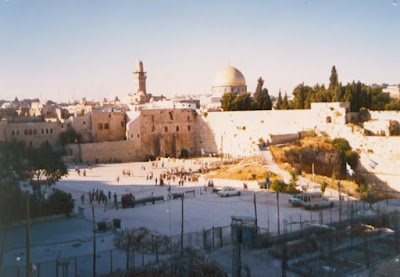 The Western Wall, Jerusalem, June 1987
After the security checkpoint, there's a couple of people posted to make sure visitors are dressed properly, and, on the men's side, the usual gaggle of men coming and going, prayer congregations in various sizes and stages of completion of the daily prayers, individuals reciting psalms or speaking from the heart, and a whole bunch of tourists just milling about aimlessly.


Over toward the mechitsa (gender divider), though, there seemed to be quite a bit of friendly cross-border communication between the men and the women. The women were praying and singing with great gusto - perhaps pointedly so, as the arrangements for men's and women's services at the Wall have been the subject of a great deal of contention. There is an organized movement for women praying at the Western Wall. From where I stood (and I didn't get close to the group, so I don't know for sure) it appeared that the men in this group were generally sympathetic to the women's right to pray expressively. At any rate, there was a great deal of audible singing and chanting from the women's side, and much conversation across the divider.
I spent a good two hours just wandering the streets of the Jewish Quarter. The Old City is like Borges' Aleph: small on the outside, but of nearly infinite size inside. But the streets are narrow like a labyrinth: it occurred to me that notwithstanding my earlier misgivings, the greatest peril to life and limb in the Old City is probably the danger of being crushed against the side of a building by a motor vehicle.
The 1948 Defenders' Plaza is spacious and lovely; down an adjoining alley, there is a memorial to those who lost their lives defending the Jewish Quarter in that war, in which all of the Quarter's 2000 Jewish inhabitants were evicted or killed. Our side took it back in 1967. 1948 Defenders' Square. (The year 1948 is represented as "Tashach" in Hebrew.)
As I sat on a bench on the Plaza, a bar mitzvah celebration came slowly winding into view. There were musicians blowing horns and banging drums, dressed in white, and, but for their long sidelocks, looking for all the world like Hare Krishnas. The boy seemed to be having the time of his life.
Jerusalem is the capital of Israel.
In Judaism, Jerusalem has been the holiest city since, according to the Hebrew Bible, King David of Israel first established it as the capital of the united Kingdom of Israel in c.1000 BCE, and his son Solomon commissioned the building of the First Temple in the city.
You get off at the bus station in Jerusalem and you're on Jaffa Street. Head east on Jaffa and you're on your way to the Old City. That's about 30 to 40 minutes on foot. There's a brand-new light rail, too, that goes along Jaffa, but I haven't been on it.
From Tel Aviv to Jerusalem is from one country to another; I'm tempted to say another planet. In Tel Aviv, you might have gotten used to advertising posters with pictures of scantily clad women; in Jerusalem, you'll be hard pressed to find pictures of women in any state of attire. That's a symptom of the growing clout of the haredi (ultra-orthodox) community, and it's been the subject of some controversy lately; more on that later. Men wearing black hats, and women wearing a skirt and a kisuy rosh (head covering) are the rule, not the exception here.
Just before reaching the Old City, I turned off Jaffa Street and followed the directions I'd been given to Salomon Street. It's the site of Tmol Shilshom, a delightful cafe/restaurant/bookstore run by a friend of a friend named David. The establishment's name derives from the novel by S. Y. Agnon. If you go to Jerusalem, you need to visit Tmol Shilshom.


David had to divide his time between working and chatting with me, but we had some great conversation. He is originally from Tel Aviv but has been living in Jerusalem for 30 years. I asked him what was on his mind these days; he mentioned Iran. He said, "If we attack Iran, we risk losing the support of the international community." (I refrained from asking, "WHAT support?") He added, "We risk losing the support of the United States."
David also talked about the disappearance of women from public spaces in Jerusalem. It was the left-leaning Ha'Aretz, he said, that blew the whistle on this some months ago. No pictures of women on advertising posters, and no female voices on public announcements - this was the new trend in Jerusalem, at the behest of the pious haredim. I do not know exactly where the matter stands now, but it's been in the news and it's an ongoing struggle.
The Old City has seven gates; the one you'll approach from Jaffa Street is the Jaffa Gate. I entered through here.
There's a tourist information office just inside. I thought it would be a good idea to stop in there before going on. I asked for a tourist map in English, and the man at the counter gave me one, but I ended up being happier with my more detailed, Hebrew-language map of Jerusalem that I'd bought from a stationery store in Tel Aviv. I kept the map as a souvenir, though.
I had just one question. "Are there any places I shouldn't go?"
He thought about it for a moment. "No," he said. "No, it's fine." I don't know much about Jerusalem, but I wanted to play it safe.
I took the tour guide's hesitation as an admonition not to push my luck, so I confined my visit to the Jewish Quarter for this trip. I found my way to the Kotel (the Western Wall) and made the obligatory pilgrimage to its smooth, stony surface. I'd visited just twice before - eighteen and 24 years ago.

After the security checkpoint, there's a couple of people posted to make sure visitors are dressed properly, and, on the men's side, the usual gaggle of men coming and going, prayer congregations in various sizes and stages of completion of the daily prayers, individuals reciting psalms or speaking from the heart, and a whole bunch of tourists just milling about aimlessly.


Over toward the mechitsa (gender divider), though, there seemed to be quite a bit of friendly cross-border communication between the men and the women. The women were praying and singing with great gusto - perhaps pointedly so, as the arrangements for men's and women's services at the Wall have been the subject of a great deal of contention. There is an organized movement for women praying at the Western Wall. From where I stood (and I didn't get close to the group, so I don't know for sure) it appeared that the men in this group were generally sympathetic to the women's right to pray expressively. At any rate, there was a great deal of audible singing and chanting from the women's side, and much conversation across the divider.

I spent a good two hours just wandering the streets of the Jewish Quarter. The Old City is like Borges' Aleph: small on the outside, but of nearly infinite size inside. But the streets are narrow like a labyrinth: it occurred to me that notwithstanding my earlier misgivings, the greatest peril to life and limb in the Old City is probably the danger of being crushed against the side of a building by a motor vehicle.
The 1948 Defenders' Plaza is spacious and lovely; down an adjoining alley, there is a memorial to those who lost their lives defending the Jewish Quarter in that war, in which all of the Quarter's 2000 Jewish inhabitants were evicted or killed. Our side took it back in 1967.

As I sat on a bench on the Plaza, a bar mitzvah celebration came slowly winding into view. There were musicians blowing horns and banging drums, dressed in white, and, but for their long sidelocks, looking for all the world like Hare Krishnas. The boy seemed to be having the time of his life.

2012-03-31


2012-03-30


2012-03-29


From Tel Aviv to Jerusalem
Israel Diary, part 4.
In Jerusalem, the dominant architectural theme is limestone; in Tel Aviv, it's Bauhaus. If you like Bauhaus, you'll love Tel Aviv.
To get from Tel Aviv to Jerusalem you catch the Egged line 405 bus. Egged's logo is a green Hebrew letter Aleph with wings; you could be forgiven for mistaking it for an X because of the way it's drawn, but it's an Aleph. The 405 leaves Tel Aviv from the Tachana Merkazit (Central Bus Station) at Retsif (platform) 607. It leaves on the hour and every 20 minutes, and takes one hour to complete the trip, give or take depending on traffic.
The bus station in Tel Aviv is in the southern part of the city, at the end of Levinsky Street. I'm told the #4 bus will get you there but I like to walk it. It's about 45 minutes on foot; you go south on Ben Yehuda and Allenby, then take Ha'Aliyah and Levinsky all the way to the end. Beginning from the corner of Bograshov, where the Maxim is, you'll pass posters for nightclubs and flyers for adult services. There are clubs and restaurants (some kosher, most not) and souvenir shops and those Judaica stores I mentioned. As you go south you get into the less touristy and more working-class neigborhoods. There are strip clubs and head shops. You'll pass a lot of derelict storefronts, failed or failing furniture and hardware stores. The population here looks to be mainly African and Russian. Down near Levinsky I see quite a few black hats, almost unknown up around the hotel.
By now I can pride myself on having the backpack check down to an art; I sling the pack over one shoulder and open the top before I get to the security guard, offering a quick "B'seder? Todah!" as I pass, and I'm on my way into the station. I've got a couple of one-shekel coins in my pocket in case I have to pee; the sherutim near the outbound gates are fee, but elsewhere the toilets are pay-to-play.
Pulling out, you pass some run-down cinderblock housing. You'll see graffiti. Here you'll see the cryptic mantra "NA NACH NACHM NACHMAN NACHMAN ME'UMAN", the signature of an ecstatic sect of hasidim, followers of Rabbi Nachman of Breslov. Elsewhere you might see "MARTIN BUBER WAS RIGHT" accompanied by Muslim, Christian, and Jewish religious symbols; it's a riposte to the original, less friendly slogan KAHANE WAS RIGHT. You'll see that one, too. And there are still those persistent posters proclaiming the late Lubavitch Rabbi the Messiah.
We are nothing if not colorful.
You get off at the bus station in Jerusalem and you're on Jaffa Street. Head east on Jaffa and you're on your way to the old city. That's about 30 to 40 minutes on foot. There's a brand-new light rail, too, that goes along Jaffa, but I haven't been on it.
From Tel Aviv to Jerusalem is from one country to another; I'm tempted to say another planet. In Tel Aviv, you might have gotten used to advertising posters with pictures of scantily clad women; in Jerusalem, you'll be hard pressed to find pictures of women in any state of attire. That's a symptom of the growing clout of the haredi (ultra-orthodox) community, and it's been the subject of some controversy lately; more on that later. Men wearing black hats, and women wearing a skirt and a kisuy rosh (head covering) are the rule, not the exception here.
In Jerusalem, the dominant architectural theme is limestone; in Tel Aviv, it's Bauhaus. If you like Bauhaus, you'll love Tel Aviv.
To get from Tel Aviv to Jerusalem you catch the Egged line 405 bus. Egged's logo is a green Hebrew letter Aleph with wings; you could be forgiven for mistaking it for an X because of the way it's drawn, but it's an Aleph. The 405 leaves Tel Aviv from the Tachana Merkazit (Central Bus Station) at Retsif (platform) 607. It leaves on the hour and every 20 minutes, and takes one hour to complete the trip, give or take depending on traffic.
The bus station in Tel Aviv is in the southern part of the city, at the end of Levinsky Street. I'm told the #4 bus will get you there but I like to walk it. It's about 45 minutes on foot; you go south on Ben Yehuda and Allenby, then take Ha'Aliyah and Levinsky all the way to the end. Beginning from the corner of Bograshov, where the Maxim is, you'll pass posters for nightclubs and flyers for adult services. There are clubs and restaurants (some kosher, most not) and souvenir shops and those Judaica stores I mentioned. As you go south you get into the less touristy and more working-class neigborhoods. There are strip clubs and head shops. You'll pass a lot of derelict storefronts, failed or failing furniture and hardware stores. The population here looks to be mainly African and Russian. Down near Levinsky I see quite a few black hats, almost unknown up around the hotel.
By now I can pride myself on having the backpack check down to an art; I sling the pack over one shoulder and open the top before I get to the security guard, offering a quick "B'seder? Todah!" as I pass, and I'm on my way into the station. I've got a couple of one-shekel coins in my pocket in case I have to pee; the sherutim near the outbound gates are fee, but elsewhere the toilets are pay-to-play.
Pulling out, you pass some run-down cinderblock housing. You'll see graffiti. Here you'll see the cryptic mantra "NA NACH NACHM NACHMAN NACHMAN ME'UMAN", the signature of an ecstatic sect of hasidim, followers of Rabbi Nachman of Breslov. Elsewhere you might see "MARTIN BUBER WAS RIGHT" accompanied by Muslim, Christian, and Jewish religious symbols; it's a riposte to the original, less friendly slogan KAHANE WAS RIGHT. You'll see that one, too. And there are still those persistent posters proclaiming the late Lubavitch Rabbi the Messiah.
We are nothing if not colorful.
You get off at the bus station in Jerusalem and you're on Jaffa Street. Head east on Jaffa and you're on your way to the old city. That's about 30 to 40 minutes on foot. There's a brand-new light rail, too, that goes along Jaffa, but I haven't been on it.
From Tel Aviv to Jerusalem is from one country to another; I'm tempted to say another planet. In Tel Aviv, you might have gotten used to advertising posters with pictures of scantily clad women; in Jerusalem, you'll be hard pressed to find pictures of women in any state of attire. That's a symptom of the growing clout of the haredi (ultra-orthodox) community, and it's been the subject of some controversy lately; more on that later. Men wearing black hats, and women wearing a skirt and a kisuy rosh (head covering) are the rule, not the exception here.
2012-03-19
Holy Grail
Israel Diary, part 3.
Religious Jews have a custom of washing hands with a two-handled cup on certain occasions: on waking in the morning, before meals featuring bread, after using the bathroom, etc. Although I've lapsed since those days, I was for a few years a practicing Orthodox Jew, and I've never really been able to shake the hold of traditional observance. It had been years since I'd washed with a washing cup, and I found myself missing the experience. So I decided this was the time to buy a wash cup; after all, I was in Israel.
I was in Israel, but I was in Tel Aviv.
From my diary:

Religious Jews have a custom of washing hands with a two-handled cup on certain occasions: on waking in the morning, before meals featuring bread, after using the bathroom, etc. Although I've lapsed since those days, I was for a few years a practicing Orthodox Jew, and I've never really been able to shake the hold of traditional observance. It had been years since I'd washed with a washing cup, and I found myself missing the experience. So I decided this was the time to buy a wash cup; after all, I was in Israel.
I was in Israel, but I was in Tel Aviv.
From my diary:
November 7, 2011I searched high and low in the touristy part of Tel Aviv, but I never did find those elusive wash cups. Two days later, though, I took the bus to Jerusalem. And the minute I got off at the Jerusalem bus station, what did I find?
Monday
16:58 (06:58 Pacific). More knick-knacks and goodies: a bottle opener (almost as elusive as the power converter, but they had it at the hardware store) and a set of silverware (also from the hardware store). From the stationery store I got a calendar and a notebook, and some maps.
Try to find a friggin' wash cup, though, and you're out of luck. They don't have religious products stores here. They do have Judaica stores, and you could probably find a fancy, gold-and-jewel-encrusted wash cup fit for King Solomon XIV, but not an ordinary one that normal people would actually use. Because, of course, normal people here don't use wash cups!

Going to Tel Aviv
Israel Diary, part 2.
Seeing Tel Aviv was one of my main goals for this trip. I'd been to Israel just twice before - the last time was in 1993 - and those were mostly religiously-oriented tours. Jerusalem, Safed (pronounced "Tsfat" but inexplicably spelled "Safed" in English), the Tomb of the Patriarchs, that kind of thing. And that was great.
But I'd never seen Tel Aviv! And later when I would tell Israeli friends that I'd been to Israel, they would say "Did you see Tel Aviv?" And I'd have to say no, and their reaction was always, "WTF?!? How do you go to Israel and not see Tel Aviv?"
So, Tel Aviv it was. I wanted to focus more on the day-to-day, real-world Israel.
So, late last year, I booked a trip to Israel and stayed in Tel Aviv. I stayed at the Maxim Hotel, recommended to me by my friend Michael Totten. I recommend it too. It's comfortable, affordable, and right on the beach. (The name, Maxim, is one of those Hebrew/English puns - 'maqsim' means "enchanting" or "charming" in Hebrew.)
It's also smack in the center of the north/south axis of Tel Aviv. Tel Aviv is not very big - it's around half the area and population of San Francisco. But unlike San Francisco, Tel Aviv is flat, and very walkable. If you are able-bodied you can reach almost any part of the city on foot.
As I mentioned, my previous visits to Israel had been religiously-oriented, and therefore did not include Tel Aviv. The city is Israel's famously secular, cosmopolitan stronghold.

 Two views of the Dan Hotel, Tel Aviv. This isn't where I stayed, but it's a landmark. The rainbow facade of the Dan was designed by the famous Israeli artist Yaakov Agam. The bullseye-patterned walkway is the Lahat Promenade, named after Tel Aviv's longtime mayor Shlomo Lahat.
 Joy Division tribute, and Pat Metheny. There is culture in Tel Aviv.
Seeing Tel Aviv was one of my main goals for this trip. I'd been to Israel just twice before - the last time was in 1993 - and those were mostly religiously-oriented tours. Jerusalem, Safed (pronounced "Tsfat" but inexplicably spelled "Safed" in English), the Tomb of the Patriarchs, that kind of thing. And that was great.
But I'd never seen Tel Aviv! And later when I would tell Israeli friends that I'd been to Israel, they would say "Did you see Tel Aviv?" And I'd have to say no, and their reaction was always, "WTF?!? How do you go to Israel and not see Tel Aviv?"
So, Tel Aviv it was. I wanted to focus more on the day-to-day, real-world Israel.
So, late last year, I booked a trip to Israel and stayed in Tel Aviv. I stayed at the Maxim Hotel, recommended to me by my friend Michael Totten. I recommend it too. It's comfortable, affordable, and right on the beach. (The name, Maxim, is one of those Hebrew/English puns - 'maqsim' means "enchanting" or "charming" in Hebrew.)
It's also smack in the center of the north/south axis of Tel Aviv. Tel Aviv is not very big - it's around half the area and population of San Francisco. But unlike San Francisco, Tel Aviv is flat, and very walkable. If you are able-bodied you can reach almost any part of the city on foot.
As I mentioned, my previous visits to Israel had been religiously-oriented, and therefore did not include Tel Aviv. The city is Israel's famously secular, cosmopolitan stronghold.


2012-03-17
Eternal Light
Israel Diary, part 1.
"Ein menorah? Menorah lo nidleket?" the guy at the hardware store asked, turning the power adapter over.
"Lo nidleket," I agreed, in my broken Hebrew. No, the little light wasn't going on.
I'd stupidly forgotten to pack a power adapter for my trip to Israel. It was my first time traveling to Israel - or anywhere outside of the United States - in eighteen years, and I'd been a bit overwhelmed at the prospect; so my packing was somewhat haphazard. But what the heck, I'd thought, I can just pick up an adapter when I get there, right? They get lots of American tourists, they must sell American power adapters. So I'll just pick one up when I get to Tel Aviv.
Easier said than done. The first such device I bought burned out almost as soon as I plugged it into my laptop. I thought replacing the fuse in the adapter might help, but as it turned out the fuse was fine; it was the adapter itself that was fried. (What, I wondered, was the point of the fuse then?) The second device wouldn't even turn on - it was inoperative right out of the box. The third one suffered a fate similar to the first. Finally I shelled out 200 shekels (about $50) for a heavy-duty adapter and was rewarded with reliable service.
Great, I thought, I can use my laptop.
Now if only this nation of Nobel laureates could produce reliable internet service....
TO BE CONTINUED
"Ein menorah? Menorah lo nidleket?" the guy at the hardware store asked, turning the power adapter over.
"Lo nidleket," I agreed, in my broken Hebrew. No, the little light wasn't going on.
I'd stupidly forgotten to pack a power adapter for my trip to Israel. It was my first time traveling to Israel - or anywhere outside of the United States - in eighteen years, and I'd been a bit overwhelmed at the prospect; so my packing was somewhat haphazard. But what the heck, I'd thought, I can just pick up an adapter when I get there, right? They get lots of American tourists, they must sell American power adapters. So I'll just pick one up when I get to Tel Aviv.
Easier said than done. The first such device I bought burned out almost as soon as I plugged it into my laptop. I thought replacing the fuse in the adapter might help, but as it turned out the fuse was fine; it was the adapter itself that was fried. (What, I wondered, was the point of the fuse then?) The second device wouldn't even turn on - it was inoperative right out of the box. The third one suffered a fate similar to the first. Finally I shelled out 200 shekels (about $50) for a heavy-duty adapter and was rewarded with reliable service.
Great, I thought, I can use my laptop.
Now if only this nation of Nobel laureates could produce reliable internet service....
TO BE CONTINUED
2012-02-24
No Justice for Zombie Mohammed
At first I thought this incident couldn't possibly be as bad as it sounded. But apparently, it is.
Volokh has an analysis.
More at Hot Air.
Think I'm making this up? I wish I were. Faith Freedom links to the news story at ABC 27.
UPDATE: Some sources incorrectly reported that Martin was a Muslim, based on a statement of Martin's which was misheard. It's not really relevant what his religion is; it's his distorted beliefs about religion and freedom of expression that are the problem.
A Pennsylvania judge reportedly dismissed charges against a Muslim man accused of attacking an atheist dressed as "Zombie Muhammad" during a Halloween parade last year.It just gets worse:
The Harrisburg Patriot-News reports that Cumberland County Magisterial District Judge Mark Martin said there wasn't enough evidence to convict Talaag Elbayomy of harrassment. Although there was grainy video of the incident, it was ruled inadmissible, leaving the case one man's word against another's, the judge said.
Elbayomy, 46, allegedly attacked Ernest Perce V, of the Parading Atheists of Central Pennsylvania, during the Oct. 11 parade in Mechanicsburg. Perce claimed Elbayomy tried to take his "Muhammad of Islam" sign and choked him, the newspaper reports. ...
... What transpired next was surreal. The Judge not only ruled in favor of the defendant, but called Mr. Perce a name and told him that if he were in a Muslim country, he’d be put to death. Judge Martin’s comments included,Go to the link for the rest of the judge's appalling comments. Andrew McCarthy has a transcript, and adds:
“Having had the benefit of having spent over 2 and a half years in predominantly Muslim countries I think I know a little bit about the faith of Islam. In fact I have a copy of the Koran here and I challenge you sir to show me where it says in the Koran that Mohammad arose and walked among the dead. I think you misinterpreted things. Before you start mocking someone else’s religion you may want to find out a little bit more about it it makes you look like a dufus and Mr. (Defendant) is correct. In many Arabic speaking countries something like this is definitely against the law there. In their society in fact it can be punishable by death and it frequently is in their society.
But one’s “attitude toward Muslims” is irrelevant to one’s right in America to walk the streets and express opinions people may find offensive without being physically attacked and intimidated. And the fact that sharia governments kill people over such expressions of opinion means that they are barbaric, not that we should tolerate additional constraints on our (diminishing) liberties. ...Harry's Place has more.
Volokh has an analysis.
More at Hot Air.
Think I'm making this up? I wish I were. Faith Freedom links to the news story at ABC 27.
UPDATE: Some sources incorrectly reported that Martin was a Muslim, based on a statement of Martin's which was misheard. It's not really relevant what his religion is; it's his distorted beliefs about religion and freedom of expression that are the problem.
2012-01-16
What Martin Luther King Did
Via Jeff Fecke at Alas, here's Hamden Rice at Angry Black Lady:
And yeah, I said for African Americans, not for Americans, because his main impact was his effect on the lives of African Americans, not on Americans in general. His main impact was not to make white people nicer or fairer. That’s why some of us who are African Americans get a bit possessive about his legacy. Dr. Martin Luther King’s legacy, despite what our civil religion tells us, is not color blind.And why should it be? The world he lived in was not color blind.
So anyway, I was having this argument with my father about Martin Luther King and how his message was too conservative compared to Malcolm X’s message. My father got really angry at me. It wasn’t that he disliked Malcolm X, but his point was that Malcolm X hadn’t accomplished anything as Dr. King had.Go to the post to read what Hamden's father told him.
I was kind of sarcastic and asked something like, so what did Martin Luther King accomplish other than giving his “I have a dream speech.”
Before I tell you what my father told me ...
Defense Department Troubled by Leaks
The Number One problem for the Secretary of Defense, apparently, is the appearance of a video showing US Marines urinating on the bodies of dead Taliban fighters. Matters came to a head when the White House characterized the incident as "deplorable" and "reprehensible". The Taliban, for their part, are unimpressed.
Dear, dear. With all these pictures whizzing around the internet, will our battlefield superiority be rendered void? Robert Wright opines:
Just as important as what gets recorded is what does not get recorded. That's why the Abu Ghraib prison that Wright and others are so fond of citing is known to the public as the place where Americans abused Iraqi prisoners and not for the torture and mass executions that occurred in Iraq's dark past under the Ba'athist regime of Saddam Hussein.
This is a good place to quote Rep. Allen West: "I do not recall any self-righteous indignation when our Delta snipers Shugart and Gordon had their bodies dragged through Mogadishu. Neither do I recall media outrage and condemnation of our Blackwater security contractors being killed, their bodies burned, and hung from a bridge in Fallujah."
The second big non-change is that hatred by itself is not dangerous to anybody. People acting from hatred are dangerous, and they are more dangerous if they have better weapons. Wright actually says as much. Wright's worry is that the enemy might get access to "massively lethal technologies". Better, then, to yield to blackmail before it starts.
Robert Wright's conclusion is typical of the accommodationist, pro-appeasement plan favored by so many mild-mannered liberals:
This is the old liberal hand-wringing mantra of "let's not do anything rash, because then we might make them even more angry". (You remember the fretting about "the Arab street" after 9/11.) It's as if the enemy's hatred is an inexhaustible resource that can always be dialed up another notch. But somehow this same principle doesn't seem to apply to our side.
Robert Wright can't picture anybody being in mortal fear of him, but fortunately for all of us the United States Marines don't have that problem. Nor, I think, do they have any shortage of hate and contempt for the enemy. And I'll bet they're plenty angry.
Because the Marines understand one simple, timeless truth:
It's better to be pissed off than to be pissed on.
Dear, dear. With all these pictures whizzing around the internet, will our battlefield superiority be rendered void? Robert Wright opines:
First, there's the new transparency of war. Infinitely more battlefield details get recorded, and everyone has the tools to broadcast these details. So it's just a matter of time before some outrageous image goes viral--pictures from Abu Ghraib, video from Afghanistan, whatever. These images will make you and your soldiers more hated by the enemy than ever--and hated by civilians who may identify with the enemy, whether because of national, ethnic, or religious kinship.First, actually, there's the old transparency of open societies, and the opacity of dictatorships. This is what ensures that we know every piddling little detail of the doings of American fighting men in Afghanistan, but nothing of what goes on behind the lines on the other side.
The second big change is that hatred is now a more dangerous thing. America faces no serious threat from any nation-state, but the more amorphous threat from radical Islam, if mishandled, could mushroom and, years from now, reach massively lethal proportions. And the lifeblood of radical Islam (like the lifeblood of many radical things) is hatred. The more Muslims there are who hate Americans, the easier life is for recruiters from al Qaeda or some other such terrorist group. ...
Just as important as what gets recorded is what does not get recorded. That's why the Abu Ghraib prison that Wright and others are so fond of citing is known to the public as the place where Americans abused Iraqi prisoners and not for the torture and mass executions that occurred in Iraq's dark past under the Ba'athist regime of Saddam Hussein.
This is a good place to quote Rep. Allen West: "I do not recall any self-righteous indignation when our Delta snipers Shugart and Gordon had their bodies dragged through Mogadishu. Neither do I recall media outrage and condemnation of our Blackwater security contractors being killed, their bodies burned, and hung from a bridge in Fallujah."
The second big non-change is that hatred by itself is not dangerous to anybody. People acting from hatred are dangerous, and they are more dangerous if they have better weapons. Wright actually says as much. Wright's worry is that the enemy might get access to "massively lethal technologies". Better, then, to yield to blackmail before it starts.
Robert Wright's conclusion is typical of the accommodationist, pro-appeasement plan favored by so many mild-mannered liberals:
In the old days national security could be had by making sure all foreign governments either liked you or feared you; now national security requires (among other things) that as few people as possible hate you.Notice that the element of "fearing you" is eliminated from the equation. Robert Wright can't picture anybody being afraid of him. (Judging by the picture, neither can I.)
This is the old liberal hand-wringing mantra of "let's not do anything rash, because then we might make them even more angry". (You remember the fretting about "the Arab street" after 9/11.) It's as if the enemy's hatred is an inexhaustible resource that can always be dialed up another notch. But somehow this same principle doesn't seem to apply to our side.
Robert Wright can't picture anybody being in mortal fear of him, but fortunately for all of us the United States Marines don't have that problem. Nor, I think, do they have any shortage of hate and contempt for the enemy. And I'll bet they're plenty angry.
Because the Marines understand one simple, timeless truth:
It's better to be pissed off than to be pissed on.
2012-01-12


Iran: Nuclear Scientist Killed
Mostafa Ahmadi-Roshan was killed in a bomb attack in Tehran the morning of January 11, Wednesday. The Iranian regime has urged the United Nations to condemn the attack. Tehran officials blamed the usual suspects - that'd be the US and the Israelis. Hillary Clinton denied any American involvement, but
Stratfor points out that this is the fifth successful assassination of an Iranian nuclear scientist in as many years. Additionally, according to Stratfor,
Go to the link for the full article.
Tom the Redhunter has a valuable roundup of related events.
Iran is warning of a "cross-border, cross-regional strategy for striking back" according to the Jerusalem Post article.
Brig. Gen. Yoav Mordechai, a spokesman for the Israel Defense Forces, said on his Facebook page Wednesday: "I have no idea who targeted the Iranian scientist but I certainly don't shed a tear."
Stratfor points out that this is the fifth successful assassination of an Iranian nuclear scientist in as many years. Additionally, according to Stratfor,
Beyond continuing a trend in assassinations, Ahmadi-Roshan's death revealed that the Iranians could be pursuing a method of uranium enrichment other than centrifuges. There are two main methods of uranium enrichment: gas centrifuges and gas diffusion. Al Jazeera reported that Ahmadi-Roshan was in charge of a project working on polymer membranes, which are necessary for gas diffusion but not for centrifuges. ...
Go to the link for the full article.
Tom the Redhunter has a valuable roundup of related events.
The MO is the similar in the targeted assassinations; two men on a motorcycle drive up next to the car while in traffic, the man on the back of the bike attaches a magnetic bomb to the car, they speed off, and a few seconds later the bomb explodes and the man inside is killed.
Iran is warning of a "cross-border, cross-regional strategy for striking back" according to the Jerusalem Post article.
2012-01-11

Israel Trip
I visited Israel - mostly Tel Aviv, with a couple of trips to Jerusalem - for the first two weeks of November 2011. Very soon, I will be posting my impressions from that visit.
Meanwhile, I'll post a couple of selections from the pictures I took.
Meanwhile, I'll post a couple of selections from the pictures I took.
Subscribe to:
Posts (Atom)